powershelldba.de
REF: PSDB-PART-2026 SCOPE: SQL Server 2016–2022 STATUS: v1.7.0
Module

Automatic SQL Server table partitioning — sqmPartitionTool

Partition existing tables, maintain them automatically (sliding window + retention), and migrate them completely into a separate archive database — with a transparent cutover via a view, so existing application code keeps running unchanged. Built on dbatools and sqmSQLTool.

PowerShell 5.1+ Built on dbatools SQL Server 2016–2022 dtcSoftware © Uwe Janke

What is sqmPartitionTool?

sqmPartitionTool is a PowerShell module by dtcSoftware (author: Uwe Janke) for the full lifecycle of a partitioned SQL Server table: from the one-time conversion of an existing table, through ongoing automatic maintenance (creating new partitions ahead of time, removing old ones after their retention period), to fully migrating an entire table into a separate archive database.

The module is built on dbatools and sqmSQLTool (reusing its logging, configuration, and WinForms theme) and supports numeric and string date-surrogate keys alongside real date columns, as well as composite keys with no single unique column — situations that come up regularly in production databases that have grown organically.

PowerShell 5.1+ dbatools sqmSQLTool ≥ 1.9.2.0 SQL Server 2016–2022

Feature highlights

In-place partitioning

Partition an existing table directly in its source database, including a variant for very large tables with little free disk space.

Sliding-window maintenance

New, empty partitions are created automatically ahead of time — the last partition never fills up.

Automatic retention

Expired partitions are removed automatically, optionally copying them to an archive database first.

Archive-DB migration with cutover

Migrate an entire table month by month into an archive database — ending with a view over the copy, transparent to existing application code.

Composite keys

Up to four columns as a key, plus numeric/string date-surrogate keys (e.g. an INT column formatted as YYYYMMDD).

GUI wizard + CLI

A WinForms wizard for the whole process — every core function also works standalone from the PowerShell console.

A — In-place partitioning

Invoke-sqmTablePartitionConversion — partition an existing table, even with little free disk space

What it does

Converts an existing, non-partitioned table into a partitioned one — pre-flight check, min/max detection, boundary calculation, filegroup creation, and the actual partitioning in one call. Works for heaps and clustered-index tables, including automatically extending the PRIMARY KEY with the partition column when needed. -Method BatchedSwap builds a new, empty partitioned copy for very large tables and moves the data in segments with periodic DBCC SHRINKFILE, instead of one single large operation.

When to use it

A table that has grown large and isn't partitioned needs to be partitioned without downtime risk. -Method BatchedSwap specifically when the disk doesn't have enough free space for a classic single-step conversion.

Common pitfalls

  • A PRIMARY KEY/UNIQUE constraint without the partition column in the key — extending it changes uniqueness semantics and must be confirmed deliberately
  • -Method BatchedSwap currently doesn't support tables with incoming foreign keys or triggers
  • Without enough free disk space, the standard method fails partway through the operation

Benefits

  • Automatically detects the right approach (constraint extension, index rebuild, or table swap)
  • Segment-by-segment migration with shrink, for environments with little free disk space
  • Automatically registers the table for automatic maintenance (scenario B)
# Partition an existing table by month
Invoke-sqmTablePartitionConversion -SqlInstance "SQL01" -Database "Sales" -Schema "dbo" -Table "OrderHistory" -PartitionColumn "OrderDate" -Granularity Month -AllowKeyChange

# Very large table, little free disk space
Invoke-sqmTablePartitionConversion -SqlInstance "SQL01" -Database "Sales" -Schema "dbo" -Table "OrderHistory" -PartitionColumn "OrderDate" -Granularity Month -Method BatchedSwap -DataCompression Page

B — Automatic maintenance

New-sqmPartitionExtendJob — sliding-window extension as a SQL Agent job

What it does

Creates a SQL Agent job that periodically runs sqm_ExtendPartitionWindow (a T-SQL procedure) — it reads the registry of all registered tables and creates new, empty partitions within the configured lead time (FutureBufferPeriods). Idempotent: running it multiple times on the same day changes nothing.

When to use it

Set this up once, right after the conversion (scenario A) — after that, extension runs automatically forever, without anyone needing to remember before "the last partition" fills up.

Common pitfalls

  • Without this job, the most recently created partition eventually fills up and new rows land in the wrong, last partition
  • Needs rights on msdb to create the SQL Agent job

Benefits

  • Fully automatic, no manual intervention after initial setup
  • Covers every table registered in sqm_PartitionRegistry at once
# Set up the maintenance job for sliding-window extension
New-sqmPartitionExtendJob -SqlInstance "SQL01"

Register-sqmPartitionTable + New-sqmPartitionRetentionJob — automatic retention and archiving

What it does

Registers a table with a retention period (-RetentionValue/-RetentionUnit) and an optional target archive database (-ArchiveEnabled/-ArchiveDatabaseName). New-sqmPartitionRetentionJob then creates the matching SQL Agent job, which removes expired partitions via Invoke-sqmPartitionArchive — optionally only after copying them to the archive database first (SWITCH PARTITION, batch copy, MERGE RANGE).

When to use it

Old partitions should disappear automatically after a set period — either deleted permanently, or copied first to a cheaper or differently-backed-up archive database.

Common pitfalls

  • Without -ArchiveEnabled, expired partitions are deleted permanently — test before using in production
  • Only affects individual partitions of a still-active table as they expire one by one — not the whole table at once (for that, see scenario C)

Benefits

  • Configurable retention in months or years
  • Optional archiving instead of deletion, with no extra manual effort
# Set up retention with archiving instead of deletion
Register-sqmPartitionTable -SqlInstance "SQL01" -Database "Sales" -Schema "dbo" -Table "OrderHistory" -RetentionValue 36 -RetentionUnit Months -ArchiveEnabled -ArchiveDatabaseName "SalesArchive"
New-sqmPartitionRetentionJob -SqlInstance "SQL01"

C — Archive-DB migration with cutover

Invoke-sqmTableArchiveMigration — move an entire table into an archive database, transparently via a view

What it does

Migrates an active table month by month, resumable via an idempotent MERGE batch procedure, into a partitioned copy in a separate archive database. Supports single-column and composite keys (up to four columns), real date columns as well as numeric/string date-surrogate keys (e.g. an INT column formatted as YYYYMMDD). -PurgeSourceAfterArchive reclaims disk space in the source via DBCC SHRINKFILE after each confirmed archived month. -CutoverToArchiveView renames the source table at the end and replaces it with a view over the archive copy — existing application code keeps accessing the same table name, unchanged.

When to use it

An entire, active table needs to move permanently to another database — e.g. a separate archive instance with a different backup/storage profile — without adjusting application code. Also suited to very large tables (hundreds of GB up to TB): progress is visible via Write-Progress and a console line per month, and stopping at any point loses nothing.

Common pitfalls

  • The target archive database must already exist — it isn't created automatically
  • A heap, or a key with more than four columns, needs an explicit -KeyColumn
  • Without an index with the date column as its leading column, every batch potentially scans the entire table — consider a suitable index first for very large tables
  • The renamed original table is never deleted automatically — deliberately, so nothing is lost, but check it manually before deleting it for good

Benefits

  • Fully resumable — a stop (network, maintenance window) loses nothing; running it again picks up exactly where it last committed
  • Transparent cutover via a view — no application code needs to change
  • The archive copy is automatically registered for its own sliding-window maintenance
  • Visible progress for migrations that can take hours to days
# Full migration with space reclaim and cutover
Invoke-sqmTableArchiveMigration -SqlInstance "SQL01" -Database "Sales" -Schema "dbo" -Table "OrderHistory" -ArchiveDatabaseName "SalesArchive" -DateColumn "OrderDate" -AllowKeyChange -PurgeSourceAfterArchive -CutoverToArchiveView

GUI wizard

Show-sqmPartitionToolGui — a WinForms wizard for the whole process

What it does

Walks step by step through connection, table selection, column selection, min/max preview, granularity, boundary preview, and execution. Step 6 offers two mutually exclusive modes: immediate migration into an archive database (scenario C), or later automated maintenance in the same database (scenario B). A "Key Column(s)" picker with the table's actual columns only appears when the key can't be derived automatically.

When to use it

For a one-time, interactively guided conversion of a table, with a preview before every critical step. For very long-running migrations (scenario C on very large tables), a direct PowerShell call is a better fit instead, since you don't want to keep the GUI window open for hours.

Common pitfalls

  • WinForms needs the desktop CLR — still available under PowerShell 7 on Windows, but not on PowerShell 7 on Linux/macOS

Benefits

  • Supports both Windows and SQL Server authentication
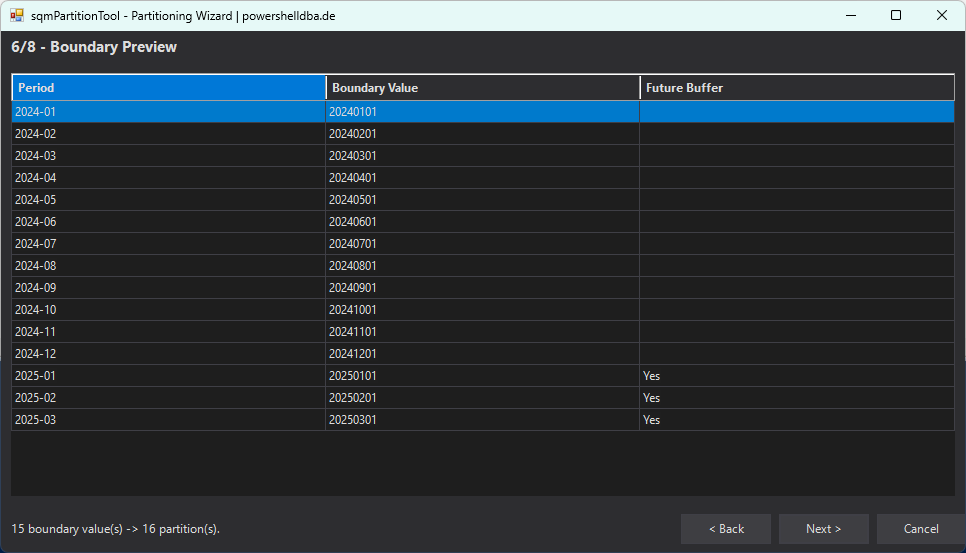
  • Boundary preview before actual execution, no surprises
  • Live log directly in the window during execution
# Open the GUI wizard
Show-sqmPartitionToolGui -SqlInstance "SQL01"
sqmPartitionTool partitioning wizard — step 6/8 boundary preview with 15 boundary values and 16 partitions, three of them marked as future buffer
Step 6/8 in the partitioning wizard: boundary preview before the actual partitioning — here, 16 monthly partitions, three already created ahead of time as a future buffer.

Quick start

Installation & first steps

# Import the module
Import-Module sqmPartitionTool

# GUI wizard
Show-sqmPartitionToolGui -SqlInstance "SQL01"

# Or directly via CLI: partition an existing table
Invoke-sqmTablePartitionConversion -SqlInstance "SQL01" -Database "Sales" -Schema "dbo" -Table "OrderHistory" -PartitionColumn "OrderDate" -Granularity Month